

Dysfunction: Gut Check, A Holistic Approach to Better Gut Health
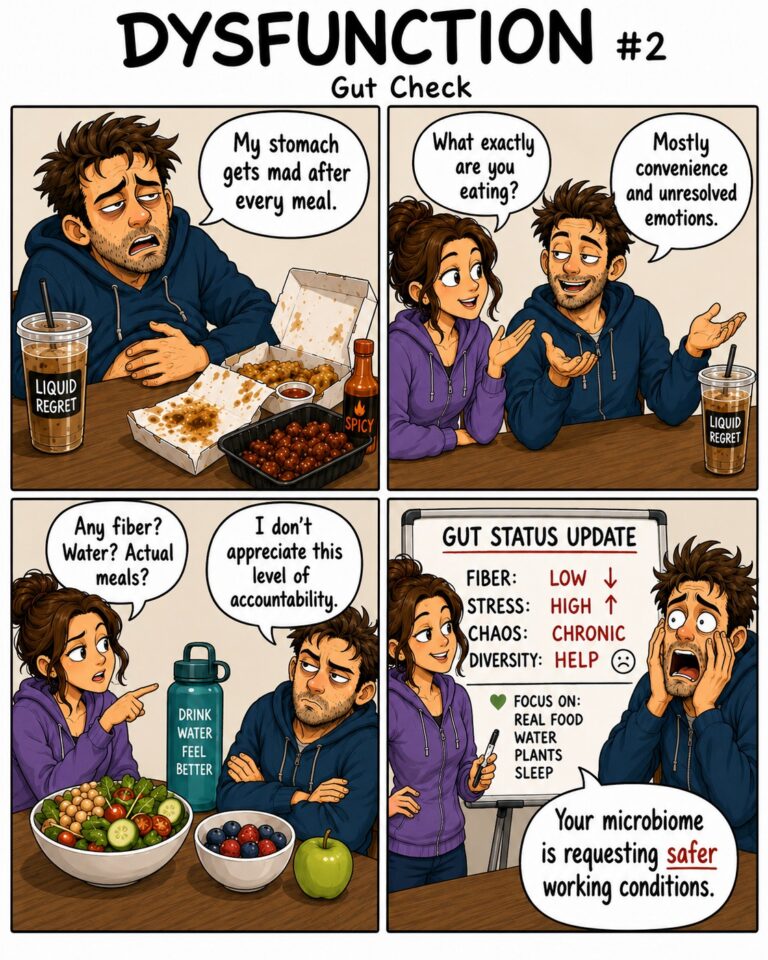
“My stomach gets mad after every meal.”
“What exactly are you eating?”
“Mostly convenience and unresolved emotions.”
Fair enough.
Our latest Dysfunction cartoon is a joke, but the idea behind it is real: Your gut pays attention to more than just what you ate for lunch.
Food matters, but so can sleep, stress, movement, hydration, medications, and your everyday habits. That is one reason a holistic approach to gut health can be helpful. Instead of looking at one symptom by itself, it can make sense to step back and look at the bigger picture. And despite what the internet sometimes suggests, better gut health usually does not require an extreme detox, a shelf full of supplements, or knowing the name of every bacterium living in your digestive tract. Sometimes the basics are a very good place to start.
What Does “Gut Health” Actually Mean?
When people talk about gut health, they usually mean the digestive system and the trillions of microorganisms living there. Together, those microorganisms are often called the gut microbiome. Researchers are still learning exactly how the microbiome affects health, but we know it plays a role in digestion, metabolism, and immune function.
We also know that food and lifestyle can influence it. That does not mean there is one perfect microbiome everyone should be trying to achieve. People are different, and digestive health is rarely that simple.
Start With Food, Fiber, and Variety
Fiber is one of the simplest ways to support digestive health. Fruits, vegetables, beans, lentils, whole grains, nuts, and seeds all contain different types of fiber. Some of that fiber helps feed the bacteria living in your gut.
Variety matters too. You do not need an exotic superfood or a complicated meal plan. Eating a wider range of real foods can provide different nutrients and different types of fiber. Fermented foods such as yogurt, kefir, sauerkraut, and kimchi may also help some people.
One word of caution: if your current diet is low in fiber, increasing it gradually may be easier on your digestive system. Going from almost no fiber to an enormous bowl of bran cereal overnight may create its own episode of Dysfunction.
Your Gut Notices More Than Food
The digestive system and nervous system communicate closely. That is one reason stress can sometimes show up as bloating, stomach discomfort, diarrhea, constipation, or changes in appetite. That does not mean digestive symptoms are “just stress.” It simply means the whole person matters.
Sleep, stress, physical activity, hydration, medications, and daily routines can all influence how someone feels.
Regular movement may help too. Walking, strength training, biking, gardening, or simply moving more during the day can support overall health and may also affect the gut microbiome. Apparently the human body remains stubbornly interested in food, water, sleep, and movement.
What About Probiotics and Supplements?
Probiotics can be useful in certain situations, but not everyone needs one. Different products contain different organisms and different strains. Evidence supporting one probiotic for one specific problem does not automatically apply to every bottle labeled “gut health.”
The same is true for many supplements. Before adding another product, it may be worth asking whether the basics are already in place.
Food. Fiber. Water. Sleep. Movement. Your microbiome may want better coworkers. That does not always mean you need to hire them from the supplement aisle.
Where Functional Medicine Fits In
A functional medicine approach to gut health often asks a simple question: What may be contributing to this problem? For someone with ongoing digestive symptoms, that may include looking at diet, medications, supplements, sleep, stress, activity, previous illness, bowel patterns, and medical history. Sometimes the answer is straightforward. Sometimes additional evaluation or testing may be appropriate.
Functional medicine should not mean assuming every digestive problem is caused by “dysbiosis,” “leaky gut,” or food sensitivity. It also should not mean automatically ordering every specialty test available. A thoughtful approach looks at the whole person, identifies patterns, and uses testing when it can answer a useful clinical question.
When Should You Get Checked?
Occasional bloating, gas, or an upset stomach happens. But ongoing or worsening abdominal pain, significant changes in bowel habits, repeated diarrhea or constipation, unexplained weight loss, blood in the stool, black stools, vomiting, or symptoms that simply are not improving deserve a closer look.
Digestive symptoms can have many different causes.
The answer is not always, “Your microbiome is off.” Sometimes we need to look deeper.
Holistic and Functional Medicine at Driftless Health
At Driftless Health, we take a holistic approach to digestive health by looking at the whole person, not just the symptom. That may include nutrition, medications, supplements, sleep, stress, activity, bowel patterns, medical history, and other factors that could be contributing to how you feel.
When appropriate, we can also discuss laboratory testing, functional medicine testing, treatment options, nutrition and lifestyle changes, or referral to a specialist.
Driftless Health provides primary medical care along with holistic and functional medicine in Viroqua, Wisconsin, with telehealth appointments available throughout Wisconsin.
Because sometimes your gut really is requesting safer working conditions. And sometimes it is worth finding out why.
About the Author
Jacob Schultz, FNP-C, is a board-certified Family Nurse Practitioner and founder of Driftless Health in Viroqua, Wisconsin. His clinical background includes emergency, family practice, and rural healthcare, with additional training in functional medicine. Learn more about Jacob
References and Further Reading
Ross FC, Patangia D, Grimaud G, et al. The interplay between diet and the gut microbiome: implications for health and disease. Nature Reviews Microbiology. 2024;22:671–686. https://doi.org/10.1038/s41579-024-01068-4
Wastyk HC, Fragiadakis GK, Perelman D, et al. Gut-microbiota-targeted diets modulate human immune status. Cell. 2021;184(16):4137–4153.e14. https://doi.org/10.1016/j.cell.2021.06.019
Min L, Ablitip A, Wang R, et al. Effects of Exercise on Gut Microbiota of Adults: A Systematic Review and Meta-Analysis. Nutrients. 2024;16(7):1070. https://doi.org/10.3390/nu16071070
Merenstein DJ, Tancredi DJ, Karl JP, et al. Is There Evidence to Support Probiotic Use for Healthy People? Advances in Nutrition. 2024;15(8):100265. https://doi.org/10.1016/j.advnut.2024.100265
Dysfunction is a Driftless Health cartoon about the occasionally ridiculous experience of living in a human body. It is intended for education and entertainment and is not individualized medical advice.