

Dysfunction: The Caffeine Loan — Caffeine, Sleep, and Your Energy Budget
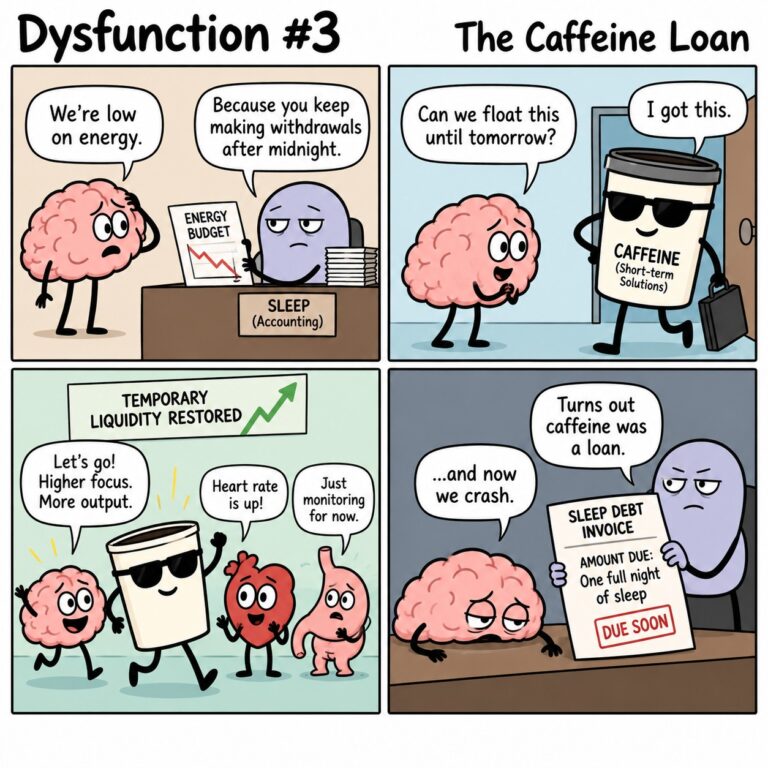
We’ve probably all taken out this loan. You didn’t sleep quite enough. Morning arrives anyway. Brain is technically open for business, but Accounting has concerns. Then caffeine walks through the door. Maybe it’s coffee. Maybe it’s tea, an energy drink, soda, or a pre-workout. Suddenly things seem manageable.
That’s the idea behind this week’s Dysfunction: The Caffeine Loan. Caffeine can improve alertness, but it doesn’t replace sleep; it doesn’t necessarily explain why we were running low on energy in the first place. Why did we need the loan?
Caffeine Helps, but It Doesn’t Create Energy
Caffeine works largely by blocking adenosine receptors, a chemical signal that increases our drive for sleep as the day goes on. In Dysfunction accounting terms, sleepiness sends an invoice. Caffeine keeps it off the brain’s desk for a while. That can improve alertness and attention. But if you slept five hours, caffeine doesn’t turn those five hours into eight.
Caffeine can also stick around longer than expected. How quickly we metabolize it varies between people, and caffeine later in the day can affect how quickly we fall asleep, how long we sleep, and sleep quality. One controlled study found measurable sleep disruption when 400 mg of caffeine was consumed even six hours before bedtime.
That can create a familiar accounting problem:
Poor sleep → fatigue → caffeine → disrupted sleep → fatigue → another loan.
Before Another Caffeinated Drink, Check the Basics
That doesn’t mean caffeine is bad.
Instead, how and why we use it can be a good reason to check in on the foundations that influence energy.
Consider:
- Sleep: Are you getting enough, and is it actually restorative?
- Stress and recovery: Is your body getting opportunities to slow down?
- Food and hydration: Are you regularly fueling the day, or relying on caffeine to carry you through?
- Movement: Are you getting regular physical activity?
- Timing: Is afternoon or evening caffeine quietly interfering with nighttime recovery?
- Amount: Are caffeine-containing drinks or products gradually adding up over the day?
Caffeine can come from many sources, including coffee, tea, soda, energy drinks, pre-workout products, and some medications or supplements. You don’t necessarily need a major wellness overhaul. Small changes can be useful.
Start With Better Sleep
If caffeine is compensating for poor sleep, one of the most useful places to start is improving the sleep opportunity itself.
That can mean keeping a fairly consistent sleep and wake time, giving yourself enough time in bed, reducing screens and stimulation before bedtime, limiting late caffeine and alcohol, keeping the bedroom cool and dark, and getting some morning light and daytime movement. None of these habits need to be perfect. The goal is simply to make it easier for your body to recognize when it is time to be awake and when it is time to recover.
Try a Small Self-Care Experiment
You do not necessarily need to quit caffeine to learn something from it. For a week or two, simply notice:
- How much caffeine are you using?
- Where is it coming from?
- What time is your last caffeinated drink or product?
- How well did you sleep the night before?
- When does your energy tend to drop?
- Are you hungry, stressed, sedentary, or genuinely sleepy when you reach for more?
Then experiment. Move caffeine earlier. Prioritize sleep for several nights. Eat regular meals. Get outside. Take a walk when the afternoon slump hits. See what changes. The goal isn’t perfection. It’s learning how your body responds.
But What If There’s More Going On?
This is where looking at fatigue through a functional and whole-person lens can become especially useful.
Instead of focusing only on: “How can I use less caffeine?” We can widen the question to evaluate how fatigue can have many interacting contributors.
Sleep and lifestyle matter, but so can chronic stress, work schedules, medications, alcohol, nutritional status, sleep disorders, iron deficiency or anemia, thyroid disease, metabolic health, mood, hormonal changes, and other medical conditions. Fatigue is often multifactorial, which is why a thoughtful history and targeted evaluation can be more useful than either ignoring it or ordering every possible test.
A functional approach should not mean assuming there is always one mysterious “root cause.” And it should not mean automatically ordering an enormous laboratory panel.
It means looking for patterns and connections.
- How are you sleeping?
- How are you eating and moving?
- What is happening with stress and recovery?
- When did your symptoms begin?
- Are there other symptoms occurring alongside the fatigue?
- Could a medication, medical condition, nutritional issue, or sleep disorder be contributing?
Sometimes the answer points toward better self-care. Sometimes basic laboratory testing or another medical evaluation makes sense. Often it is a combination. That is one of the benefits of whole-person care. Instead of treating the afternoon caffeine as the problem, there is room to understand the person who keeps needing it.
At Driftless Health, that is part of how we approach primary care, prevention, and functional medicine, combining appropriate medical evaluation with practical attention to sleep, nutrition, movement, stress, recovery, and everyday life. Because much of health happens between healthcare visits.
So, Is Caffeine the Problem?
Usually, not by itself. The better question may be whether caffeine is something you enjoy or something you increasingly depend on to compensate for an energy problem that deserves a closer look.
Enjoy the coffee, tea, or other caffeinated drink if it works for you. Just occasionally check the balance sheet. Because if Caffeine keeps arriving with a briefcase every morning, Sleep Accounting may have a few questions. Turns out caffeine was a loan.
Jacob is a Family Nurse Practitioner and founder of Driftless Health in Viroqua, Wisconsin. Educational content may include editorial support and is reviewed for clinical accuracy, clarity, and practical relevance.
A Little More Reading
Clark, I., & Landolt, H. P. (2017). Coffee, caffeine, and sleep: A systematic review of epidemiological studies and randomized controlled trials. Sleep Medicine Reviews, 31, 70–78. https://doi.org/10.1016/j.smrv.2016.01.006
Drake, C., Roehrs, T., Shambroom, J., & Roth, T. (2013). Caffeine effects on sleep taken 0, 3, or 6 hours before going to bed. Journal of Clinical Sleep Medicine, 9(11), 1195–1200. https://doi.org/10.5664/jcsm.3170
Gardiner, C., Weakley, J., Burke, L. M., Roach, G. D., Sargent, C., Maniar, N., Townshend, A., & Halson, S. L. (2023). The effect of caffeine on subsequent sleep: A systematic review and meta-analysis. Sleep Medicine Reviews, 69, 101764. https://doi.org/10.1016/j.smrv.2023.101764
Ho, D. C. H., & Zheng, R. M. (2022). Approach to fatigue in primary care. Singapore Medical Journal, 63(11), 674–678. https://doi.org/10.4103/SINGAPOREMEDJ.SMJ-2021-118
Reichert, C. F., Deboer, T., & Landolt, H. P. (2022). Adenosine, caffeine, and sleep-wake regulation: State of the science and perspectives. Journal of Sleep Research, 31(4), e13597. https://doi.org/10.1111/jsr.13597
Dysfunction is a Driftless Health cartoon series about the occasionally ridiculous experience of living in a human body. It is intended for education and entertainment and is not individualized medical advice.