

Dysfunction: One More Episode, Why Sleep Usually Wins
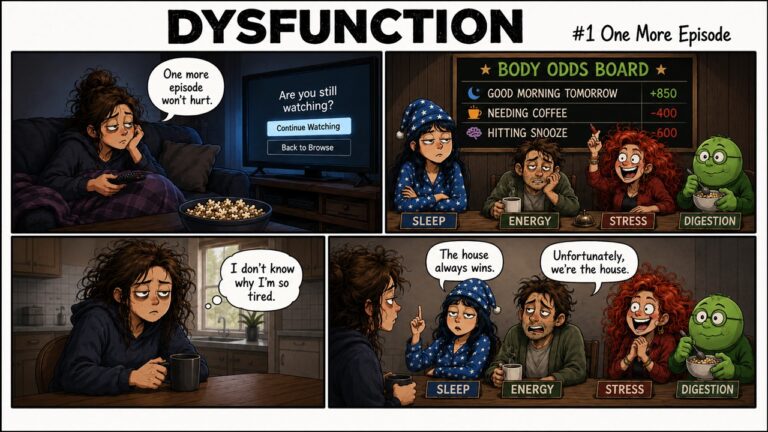
We’ve all made this bet. “I should probably go to bed…but one more episode won’t hurt.” Then morning arrives, the alarm goes off, coffee becomes less of a beverage and more of a requirement, and we wonder: “Why am I so tired?”
Meanwhile, somewhere inside Dysfunction, Sleep and Energy already knew how this would end. The house always wins. Unfortunately, we’re the house.
Your Body Really Does Notice
Sleep isn’t simply the time when your body “turns off.” While you’re sleeping, your brain and body are doing important work related to memory, attention, mood, metabolism, immune function, and recovery. For most healthy adults, regularly getting at least seven hours of sleep per night is associated with better overall health. Consistently sleeping less than that has been linked with several health concerns. And you don’t necessarily need weeks of poor sleep to notice the effects.
A 2024 review of 44 studies found that even one night of shortened sleep increased daytime sleepiness and made it harder for people to maintain attention. In everyday life, that may look like feeling foggy, reaching for another cup of coffee, having trouble concentrating, or simply not feeling quite like yourself.
Sleep Can Affect More Than Energy
There’s a reason several “body systems” might be interested in what time you go to bed.
Research has found that sleep loss can affect mood and emotional well-being, including how we respond emotionally to everyday situations. Sleep can also influence hunger, appetite, and food choices. Research examining sleep restriction has found changes in hunger, food intake, eating frequency, and portion sizes.
So the morning after a short night, Energy may not be the only thing keeping score.
Real Life Doesn’t Always Cooperate
Of course, knowing that sleep is important doesn’t mean getting enough of it is always simple. We all have different seasons of life. A parent with a new baby may have very different nights than someone whose children are grown. Shift workers, healthcare workers, first responders, farmers, caregivers, students, and people working multiple jobs may have schedules that simply don’t fit neatly into an ideal bedtime routine.
Stress matters too. So do children, work schedules, family responsibilities, illness, travel, relationships, and the countless unexpected things that come with being human. Sometimes the choice isn’t between eight hours of sleep and watching another television episode. Sometimes life simply requires us to be awake. That practical reality matters.
The goal isn’t to make people feel guilty about sleep they couldn’t get. It’s to recognize that, when we do have some control over the choice, giving ourselves the best opportunity for adequate rest can help tilt the odds in our favor.
It’s the Pattern, Not One Night
Staying up late to finish a great movie, spend time with friends, care for a child, work a night shift, or simply enjoy life isn’t a health catastrophe. Human bodies are remarkably adaptable. What matters more is the pattern over time. If five or six hours of sleep has become the usual routine, mornings regularly require several alarms, or fatigue seems to follow you through the day, it may be worth looking for small changes that are realistically possible.
- Maybe that means going to bed 30 minutes earlier.
- Maybe it means protecting sleep on the nights when your schedule allows it.
- Maybe it means turning off the phone a little sooner.
- And sometimes it means accepting that this particular season of life is difficult and simply doing the best you can until circumstances change.
If sleep or fatigue remains a persistent part of your experience, it may be worth discussing the bigger picture with a qualified healthcare professional. At Driftless Health, conversations about sleep, energy, and daily functioning can help you look more closely at the factors that may be contributing to ongoing symptoms and work toward their root causes.
There is no perfect sleep score.
But when life gives us the opportunity, trying to get enough good-quality rest is one of the better ways to play the odds. Sleep would probably take that bet.
About the Author
Jacob Schultz, FNP-C, is a board-certified Family Nurse Practitioner and founder of Driftless Health in Viroqua, Wisconsin. His clinical background includes emergency, family practice, and rural healthcare, with additional training in functional medicine. Learn more about Jacob
References and Further Reading
Watson, N. F., Badr, M. S., Belenky, G., Bliwise, D. L., Buxton, O. M., Buysse, D., … & Heald, J. L. (2015). Recommended amount of sleep for a healthy adult: a joint consensus statement of the American Academy of Sleep Medicine and Sleep Research Society. Journal of Clinical Sleep Medicine, 11(6), 591-592. https://doi.org/10.5664/jcsm.4758
Tomaso, C. C., Johnson, A. B., & Nelson, T. D. (2021). The effect of sleep deprivation and restriction on mood, emotion, and emotion regulation: three meta-analyses in one. Sleep, 44(6), zsaa289. https://doi.org/10.1093/sleep/zsaa289
Wüst, L. N., Capdevila, N. C., Lane, L. T., Reichert, C. F., & Lasauskaite, R. (2024). Impact of one night of sleep restriction on sleepiness and cognitive function: A systematic review and meta-analysis. Sleep medicine reviews, 76, 101940. https://doi.org/10.1016/j.smrv.2024.101940
Soltanieh, S., Solgi, S., Ansari, M., Santos, H. O., & Abbasi, B. (2021). Effect of sleep duration on dietary intake, desire to eat, measures of food intake and metabolic hormones: a systematic review of clinical trials. Clinical nutrition ESPEN, 45, 55-65. https://doi.org/10.1016/j.clnesp.2021.07.029
Dysfunction is a Driftless Health cartoon about the occasionally ridiculous experience of living in a human body. It is intended for education and entertainment and is not individualized medical advice.